Programmable intracellular RNA scaffolds for integrating sensing and regulation
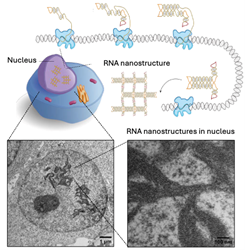 
Co-transactionally folded RNA nanostructures in living cells.
Invention Summary:
Biomarker validation and intracellular RNA detection require tools that are precise, scalable, and capable of capturing complex gene expression patterns. Current approaches, including CRISPR-based systems, RNA interference, and RNA sponge technologies, are often limited by a single-target focus, reliance on protein components, off-target effects, or a lack of structural organization. These limitations restrict their ability to perform multiplex RNA sensing and pathway-level analysis in living cells, which is increasingly needed in diagnostics, drug discovery, and functional genomics.
Rutgers researchers have developed a novel RNA nanostructure platform that self-assembles inside living human cells, enabling programmable and multiplex interactions with RNA and protein targets. Unlike existing RNA technologies, these co-transcriptionally folded RNA lattices form ordered, stable nanostructures that can integrate multiple functional modules, including sensing and binding domains, such as the KRAS proto-oncogene associated with pancreatic and colorectal cancers. This platform enables simultaneous detection and modulation of multiple intracellular targets, providing a new approach for studying complex biological pathways and developing next-generation diagnostic and therapeutic strategies.
Market Applications:
- Multiplex RNA sensing for biomarker detection in cancer and other diseases
- Cell-based assay platforms for drug discovery and pathway analysis
- Functional genomics tools for studying gene regulatory networks
- Future applications in therapeutic targeting of oncogenic pathways
Advantages:
- Multiplex capability - simultaneous targeting of multiple RNAs and proteins
- Ordered nanostructure architecture - improved stability and reduced crosstalk
- Protein-free system - avoids delivery and regulatory challenges of CRISPR-based systems
- Nuclear retention - enables interaction with transcriptional and regulatory processes
- Modular and programmable design - adaptable to different targets and applications
- Platform-focused- review this link.
Publications:
- Chang, X., Jeziorek, M., Yang, Q. et al. Designer RNA nanostructures co-transcribed and self-assembled inside human cell nuclei. Nat Commun 17, 1055 (2026)
- H. Yan, F. Zhang, X. Qi, “Highly knotted molecular topologies from single‐stranded nucleic acids”, United State patent application number 17/050,918
- H. Yan, Y. Chang, X. Liu, F. Zhang, X. Qi, “RNA nanostructures and methods of making and using RNA nanostructures” US Patent 11,254,941
- Y. Chang, H. Yan, X. Qi, F. Zhang, “RNA‐nanostructured double robots and methods of use thereof”, US Patent 11,242,533
Intellectual Property & Development Status: Provisional application filed. Patent pending. Available for licensing and/or research collaboration. For any business development and other collaborative partnerships, contact: marketingbd@research.rutgers.edu
Patent Information:
| Title |
App Type |
Country |
Serial No. |
Patent No. |
File Date |
Issued Date |
Expire Date |
Patent Status |
|
|
|
ID: 2025-270
Category:
Inventors:
Keywords:
|