Programmable RNA Lattice Platform for Intracellular Molecular Display and Assembly
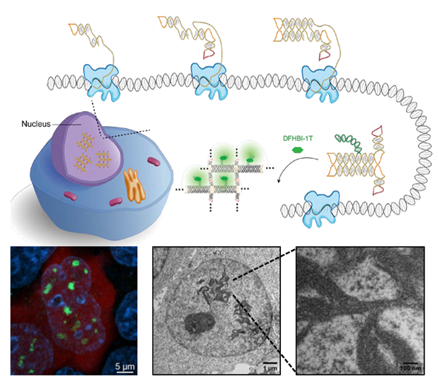 
Representative co-transactionally folded RNA lattices displaying light-up aptamers (green) in living cells.
Invention Summary:
The ability to design and arrange functional RNA elements in defined intracellular architectures is increasingly important for target validation, assay development, synthetic biology, and therapeutic discovery. Current technologies such as antisense oligonucleotides (ASOs), RNA interference, CRISPR-based systems, and conventional linear RNA constructs primarily act through knockdown, editing, or single-site binding, but they do not provide programmable control over the density, spacing, stoichiometry, and patterning of RNA functional elements inside living cells. What is still missing is a modular intracellular scaffold technology that enables partners to build custom RNA-based assemblies for discovery, assay development, and translational programs.
Rutgers researchers Dr. Fei Zhang, Leo Chang, Maciej Jeziorek, and Dr. Jean Pierre Etchegaray have developed a novel RNA nanostructure platform that self-assembles inside living human cell nuclei and serves as a programmable intracellular molecular scaffold. These co-transcriptionally folded RNA lattices encode structural and functional RNA domains within a single transcript, enabling co-folding into ordered, stable assemblies that define the geometry, valency, spacing, ratio, and pattern of displayed functional elements (Figure). The platform can incorporate diverse RNA functional elements, including antisense or guide-like targeting domains, miRNA/siRNA interaction elements, protein-binding aptamers, endogenous RBP-binding motifs, aptamer-based sensing modules, and catalytic or regulatory RNA elements, to build partner-defined intracellular assemblies for target validation, assay development, synthetic biology, and future RNA and gene-therapy applications.
Market Applications:
- Target validation: Evaluate RNA-binding proteins and RNA-regulatory pathways in disease-relevant systems.
- Assay development: Build intracellular RNA-display systems for screening, sensing, and mechanism studies.
- Synthetic biology enablement: Construct programmable multivalent RNA assemblies in mammalian cells.
- Partnered platform integration: Support RNA therapeutics, gene therapy, diagnostics, and custom R&D programs.
Advantages:
- Programmable molecular display: Arrange multiple RNA functional elements in one encoded intracellular scaffold.
- Architectural control: Define valency, spacing, ratio, and pattern beyond conventional linear or repeat-based RNAs.
- Single-construct implementation: Enable intracellular co-folding and self-assembly from one encoded transcript.
- Differentiated RNA modality: Provide an RNA-only alternative to protein-dependent engineering systems.
Publications:
- Chang, X., Jeziorek, M., Yang, Q. et al. Designer RNA nanostructures co-transcribed and self-assembled inside human cell nuclei. Nat Commun 17, 1055 (2026)
- H. Yan, F. Zhang, X. Qi, “Highly knotted molecular topologies from single‐stranded nucleic acids”, United State patent application number 17/050,918
- H. Yan, Y. Chang, X. Liu, F. Zhang, X. Qi, “RNA nanostructures and methods of making and using RNA nanostructures” US Patent 11,254,941
- Y. Chang, H. Yan, X. Qi, F. Zhang, “RNA‐nanostructured double robots and methods of use thereof”, US Patent 11,242,533
Intellectual Property & Development Status: Provisional application filed. Patent pending. Available for licensing and/or research collaboration. For any business development and other collaborative partnerships, contact: marketingbd@research.rutgers.edu
Patent Information:
| Title |
App Type |
Country |
Serial No. |
Patent No. |
File Date |
Issued Date |
Expire Date |
Patent Status |
|
|
|
ID: MP-2025-270
Category:
Inventors:
Keywords:
|