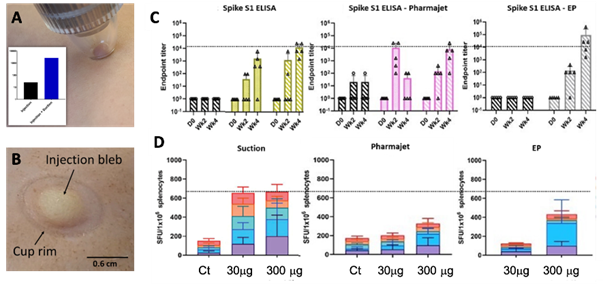
Fig.1. Dermal suction induces long-lasting antigen expression and T-cell response. (A) Dermal suction via a small hand-held device with a 6-mm orifice against the skin. Inset: immune response is 100 times stronger when compared with injection alone. (B) Post-suction skin demonstrates no damage nor erythema. (C) and (D): Benchmarking of suction against PharmaJet and electroporation (EP): suction produces equal antibody response (C) and more superior T-cell response (D) in an animal model. These trends were reproduced in human clinical trials3 where antibody responses lasted up to 48 weeks and) T-cell responses were two-logs stronger against all published DNA and mRNA data, also up to 48 weeks.
Invention Summary:
DNA vaccines and DNA‑encoded therapeutics offer compelling advantages against nucleic-acid-based alternatives, including longevity of expression, superior T-cell response, rapid development, scalable manufacturing, and significantly simplified logistics due to stability against extreme temperatures. However, their broader clinical adoption has been constrained by inefficient in vivo delivery. Conventional intradermal or subcutaneous injection of naked DNA results in low cellular uptake and weak gene expression. While electroporation can enhance transfection efficiency, it is associated with significant drawbacks such as pain, local tissue damage, equipment complexity, high cost, and the need for specialized training. These limitations reduce patient acceptance and restrict scalability, particularly for routine vaccination or deployment in low‑resource settings. A safe, simple, and effective alternative in-vivo delivery approach remains a critical unmet need.
Rutgers researchers have developed a new approach of employing negative pressure to facility DNA delivery to subcutaneous sites. The approach involves intradermal or shallow subcutaneous injection of plasmid DNA, immediately followed by brief application of localized mild vacuum suction at the injection site. The applied negative pressure induces transient tissue deformation and strain in the epidermis and dermis, which enhances cellular uptake of DNA through mechanosensitive endocytic pathways. Both preclinical studies in various animal models1, 2 and clinical trials3demonstrated rapid onset and sustained transgene expression, and strong, long lasting antibody response out to 48 weeks. Furthermore, the T-cell response is superior when benchmarked against published data on all current DNA and mRNA vaccines. Importantly, effective delivery is achieved via a cost-effective handheld device, without detectable tissue injury or inflammation, distinguishing this method from electroporation while maintaining comparable or superior immunogenicity.
Market Applications:
- DNA vaccines for infectious diseases, oncology, and biodefense
- DNA‑encoded protein therapeutics and immunomodulators
- Gene therapy requiring safe and effective DNA transfection
Advantages:
- Superior T-cell response
- Easy of operation, cost-effective device, and self-administration possible
- Reduced pain, minimal adverse effects and excellent patient tolerability as proven by clinical trials
- Scalable and compatible with existing plasmid formulations
- Proven superiority when benchmarking against electroporation and other invasive delivery methods
Publications:
(1) Lallow, E. O., et al.Novel suction-based in vivo cutaneous DNA transfection platform. Science advances 2021, 7 (45), eabj0611.
(2) Jeong, M., et al. Immune responses of a novel bi-cistronic SARS-CoV-2 DNA vaccine following intradermal immunization with suction delivery. Frontiers in virology 2022, 2, 891540.
(3) Kim, W. J., et al.Safety and immunogenicity of the bi-cistronic GLS-5310 COVID-19 DNA vaccine delivered with the GeneDerm suction device. International journal of infectious diseases 2023, 128, 112-120.
Intellectual Property & Development Status: US Patent 12,508,409 and US Patent Application 19/435,278. Available for licensing and/or research collaboration. For any business development and other collaborative partnerships contact marketingbd@research.rutgers.edu.