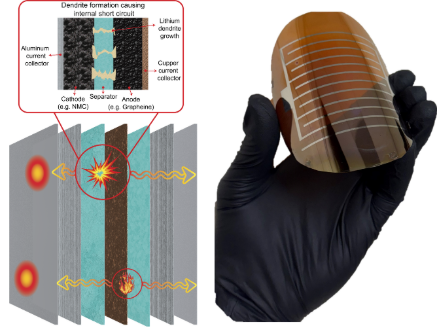
A thin-film sensor integrated within battery cells rapidly detects millimeter scale hotspots
to guarantee thermal safety and expand safe operation envelope
Invention Summary:
Current battery thermal sensing technologies such as thermistor arrays and fiber-optic sensors lack sufficient spatial resolution and rapid response to detect early-stage overheating within lithium-ion cells. These approaches are complex, costly, and often detect temperature rise only after heat has already spread, limiting their ability to prevent thermal runaway and battery failure.
Rutgers researchers developed a flexible oxide thin-film thermal sensor that enables real-time hotspot detection in the entire battery cell volume with <1 mm resolution and <2 s response time. The sensor provides up to 10× improvement over existing technologies while requiring only two electrical connections significantly reducing readout complexity, offering a scalable solution for safer batteries, fast charging, and next-generation energy storage systems.
Market Applications:
Advantages:
Intellectual Property & Development Status: Provisional application filed. Patent pending. Available for licensing and/or research collaboration. For any business development and other collaborative partnerships, contact: marketingbd@research.rutgers.edu