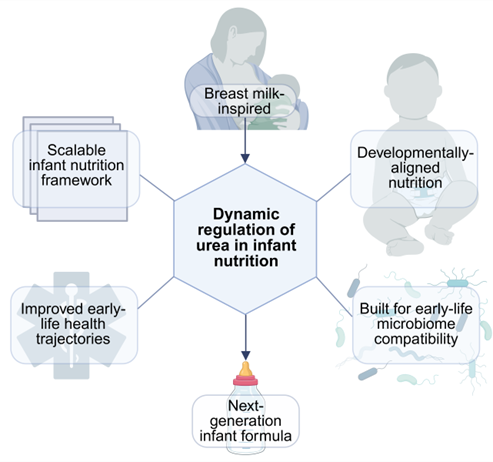

Synchronizing infant nutrition with early-life biology. Rutgers researchers propose replacing static infant nutrition with formulations inspired by human breast milk. Regulated urea delivery aligned with infant developmental needs and microbiome sustenance enables next-generation nutrition for infants.
Invention Summary:
Current infant nutritional products, including formulas, typically provide fixed urea levels that do not reflect the temporally regulated fluctuations observed in human breast milk across early life. Such static formulations are not designed to account for age- or time-of-day-dependent changes in infant nutritional requirements, as the gut microbiome matures.
Rutgers researchers have invented a new type of infant nutritional supplementation inspired by the dynamically changing composition of human breast milk to support the development of a healthy infant gut microbiome. The proposed approach is designed to provide precisely regulated urea concentrations that follow natural age- and time-of-day patterns, closely mimicking those observed in breastfed infants. By aligning urea delivery with early-life biological rhythms, this approach supports the growth of beneficial, urease-positive bacteria in the developing infant microbiome and promotes healthy gut development necessary for long-term health. Paired with compatible urease-positive probiotics and diagnostic and monitoring tools, this invention offers a next-generation framework for infant nutrition.
Market Applications:
- Improved infant nutrition inspired by the dynamic composition of human breast milk
- Targeted dietary supplements designed to support early-life gut health
- Suitable for therapeutic intervention in gut microbiome restoration
Advantages:
- Provides a more physiologically aligned option for infants who are partially or fully formula-fed
- Designed for use in populations at increased risk of early-life microbiome disruptions
- May help in the management of infant intestinal disorders
Intellectual Property & Development Status: Provisional patent application filed. Available for licensing and/or research collaboration. For any business development and other collaborative partnerships contact marketingbd@research.rutgers.edu.