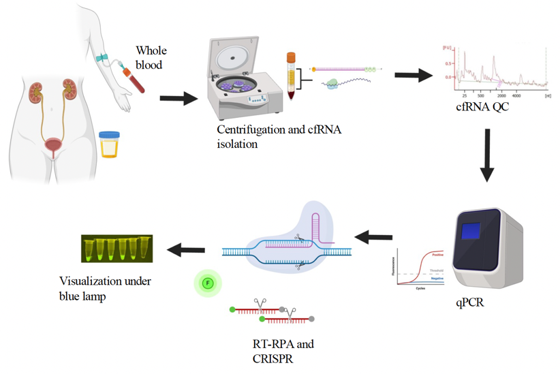

Overall ROCBD work-flow involving blood collection
Invention Summary:
Cost‐effective, sensitive, and timely detection of oncogenic signals allows early cancer diagnosis and leads to better oncologic outcomes in cancer patients. Liquid biopsies are becoming integral parts of clinical management due to their non‐invasive nature and ability to provide real‐time monitoring of tumor progression, but most applications are based on cell-free DNA. Cell‐free RNA is abundantly present in circulation and can indicate real‐time gene expressions of cancer biomarkers, offering multiple unique advantages for cancer diagnosis.
Rutgers researchers have developed a cost-effective, ultra-sensitive CRISPR-Cas12a-based liquid biopsy technology enabling rapid, non-invasive cancer detection from blood and urine. Rapid Oncogenic cfRNA Biomarker Detection (ROCBD) is a novel cancer biomarker detection method that leverages CRISPR-Cas12a technology to sensitively detect oncogenic signals through cell-free RNA (cfRNA) found in liquid biopsies such as blood and urine. By targeting traditional biomarkers like CEA along with novel biomarkers derived from the L1 retrotransposon element (which covers 17% of the human genome), ROCBD achieves exceptional specificity and sensitivity. The process requires only 50 minutes at room temperature with no specialized equipment, making it suitable for rapid clinical use and potential point-of-care testing. This technology has demonstrated success in detecting bladder cancer biomarkers and predicting recurrence, offering a non-invasive alternative to traditional biopsies and imaging.
Market Applications:
- Early cancer detection through liquid biopsy diagnostics
- Clinical monitoring and management of cancer progression and recurrence
- Point-of-care cancer diagnostic testing
Advantages:
- Non-invasive, high sensitivity and specificity at attomolar levels
- Rapid assay without advanced equipment
- Incorporates unique cancer-specific biomarkers from the dark genome, expanding detection coverage
- Potential for development as a point-of-care test using a simple testing strip
- Enables early cancer detection and real-time clinical management
Intellectual Property & Development Status: Provisional application filed. Patent pending. Available for licensing and/or research collaboration. For any business development and other collaborative partnerships, contact: marketingbd@research.rutgers.edu